


Finding Value in a Momentum-Driven Market
10 min read

Fourth Quarter 2025 Commentary
Stock price momentum1 was the defining force across global equity markets in 2025, marking the second consecutive year of momentum leadership in the U.S. and a similarly strong outcome outside the U.S.
Three themes stand out:
- Momentum stocks have outperformed by roughly 17 percentage points in U.S. and 22 percentage points in non-U.S. developed markets.
- The stocks and valuation cohorts driving returns are broadly consistent with historical momentum cycles.
- Periods of pronounced momentum have historically created attractive long-term opportunities for value-oriented investors.
MOMENTUM AT AN EXTREME, BUT NOT EVERYWHERE
The past year has been dominated by momentum strategies across developed markets. That has been true both within and outside of the U.S., though the character of leadership has evolved over time. Momentum performance has been striking in both U.S. and non-U.S. developed markets (Exhibit 1).
The path has not been smooth. Momentum stocks declined sharply ahead of Trump’s “Liberation Day”, raising questions about whether leadership was finally breaking. That drawdown proved temporary, as momentum rebounded sharply throughout the remainder of the year. Since Liberation Day, leadership has taken on a more speculative tone. Performance has increasingly been driven by sentiment rather than fundamentals. Measured over the last twelve months, momentum’s outperformance versus the market sits at historically extreme levels in both the U.S. and non-U.S. developed markets. At the global level, overall momentum outperformance appears elevated but less excessive due to the incorporation of emerging markets, where momentum has been less significant.
Exhibit 1: Momentum Has Significantly Outperformed
| 2025 Momentum Outperformance | Percentile Among Rolling 12m Periods | |
| U.S. Large Cap | +17.1% | 93% |
| U.S. Small Cap | +10.9% | 77% |
| Global | +11.5% | 76% |
| EAFE | +22.4% | 95% |
| Europe | +28.7% | 99% |
| Emerging Markets | +7.5% | 59% |
Source: Empirical Research Partners, Pzena analysis Momentum is defined as the best quintile of the universe, measured by the nine-month daily price trend. Outperformance is defined as the return of momentum minus the return of the universe. All data are equal-weighted, in US dollars, as of December 31, 2025. US Large Cap = the largest ~750 US stocks. US Small Cap = US stocks ranked #751–#2,750 by market capitalization. Global = MSCI ACWI universe. EAFE = MSCI EAFE universe. Europe = MSCI Europe universe. EM = MSCI EM universe. US Large Cap data start date = February 1, 1952. US Small Cap data start date = January 1, 1965. Global and non-U.S. data start date = January 1, 1992. Does not represent any specific Pzena product or service. Past performance is not indicative of future returns.
These are elevated readings, but the sources of momentum matter.
MOMENTUM, SPECULATION, AND LONG-TERM EVIDENCE
Momentum and value are not opposites, nor are they inherently complementary. They can move together or diverge depending on market structure and investor behavior.
Over long horizons, both approaches have outperformed2. Strategies focused on value and those focused on momentum have each produced annualized returns of roughly 14 percent, despite following very different paths along the way3. The difference has always been timing.
Historically, the most challenging periods for value have tended to coincide with late-stage momentum, when returns become increasingly driven by speculative behavior rather than improving fundamentals. During the dot-com bubble, momentum leadership shifted decisively toward unprofitable and highly speculative companies, leaving many high-quality businesses behind. The current environment shows elements of that pattern, though history rarely repeats cleanly.
U.S. MARKETS AND VALUATION EXTREMES
In the U.S., leadership over the past year has again been narrow. High-growth mega-cap stocks dominated earlier in the cycle, reinforcing trends that have been in place for several years.
Since Liberation Day, leadership has broadened in a less constructive way, as momentum leadership has taken on a more speculative character. Meme stocks, SPACs, highly shorted stocks, and unprofitable companies have been among the strongest performers, echoing past episodes where momentum became increasingly detached from fundamentals.
The U.S. alpha chart illustrates how valuation cohorts behave during high-momentum regimes (Exhibit 2).
Exhibit 2: U.S. Valuation Quintile Performance By Momentum Regime
Average Rolling Excess Returns in High Momentum Periods 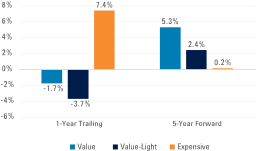
Source: Empirical Research Partners, Sanford C. Bernstein & Co., Pzena analysis. High Momentum = top tercile of momentum excess-return periods, based on trailing 12-month relative returns vs. the universe. Momentum is defined as the best quintile of the universe, measured by the nine-month daily price trend. Value = stocks within the cheapest quintile based on price/book of the 1000 largest US stocks (ranked by market cap). Value-Light = 2nd cheapest quintile. Expensive = most expensive quintile. The quintiles are measured on an equally weighted basis. Excess return is calculated vs. the cap-weighted market (1000 largest US stocks). Total return data are annualized, in US dollars, from January 1, 1960 to December 31, 2025. Does not represent any specific Pzena product or service. Past performance does not predict future returns.
During high-momentum periods, cheap stocks have historically lagged, while expensive stocks have generated the highest alpha. This year’s results are consistent with that history. What also aligns with history is what has been left behind. High-quality, fundamentally strong companies have lagged as capital has flowed toward more speculative opportunities.
After periods of extreme and speculative momentum, forward returns have historically shifted considerably. Cheap stocks have gone on to outperform meaningfully over the subsequent five years, while expensive and speculative stocks have struggled as expectations reset.
NORMAL PERIODS FAVOR VALUE
Outside of extreme momentum regimes, valuation effects have asserted themselves more reliably. In normal periods, cheap stocks have tended to outperform over the trailing twelve months and continue to outperform over the following five years. Expensive stocks have shown a different pattern; they often lag initially, then recover modestly, but they still trail value-oriented cohorts over full cycles. Value-light stocks trailed value stocks by 200-300 basis points in all periods.
NON-U.S. DEVELOPED MARKETS LOOK DIFFERENT
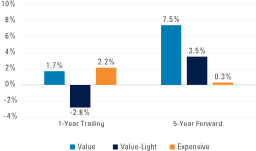
While momentum was just as strong outside the U.S. in 2025, the most expensive stocks have not historically dominated high-momentum periods in the same way they have in the U.S. (Exhibit 3).
Exhibit 3: EAFE Valuation Quintile Performance By Momentum Regime
Average Rolling Excess Returns in High Momentum Periods
Source: Empirical Research Partners, Sanford C. Bernstein & Co., Pzena analysis High Momentum = top tercile of momentum excess-return periods, based on trailing 12-month relative returns vs. the universe. Momentum is defined as the best quintile of the universe, measured by the nine-month daily price trend. Value = stocks within the cheapest quintile based on price/book of the MSCI EAFE universe. Value-Light = 2nd cheapest quintile. Expensive = most expensive quintile. The quintiles are measured on an equally weighted basis. Excess return is calculated vs. the cap-weighted MSCI EAFE universe. Total return data are annualized, in US dollars, from January 1, 1992 to December 31, 2025. Does not represent any specific Pzena product or service. Past performance does not predict future returns.
Leadership in non-U.S. developed markets has historically been broader, with value stocks participating more meaningfully even during momentum-led advances. Structural differences, including fewer large, narrative-driven growth companies, have limited the degree of speculative excess.
As a result, momentum and value have more often been coincident outside the U.S. Performance for the past year across valuation cohorts is consistent with the longer-term pattern.
EMERGING MARKETS REINFORCE THE PATTERN
Emerging markets provide an additional reference point. Momentum performance has been more moderate in emerging markets, in stark contrast to the more extreme outcomes seen in developed markets.
When momentum outperforms in emerging markets, leadership tends to resemble non-U.S. developed markets rather than the U.S. Historically, performance has been broader, and value-oriented stocks have remained competitive rather than being crowded out. This helps explain why global momentum outperformance appears less extreme than U.S.-only measures suggest.
AN OPPORTUNISTIC SETUP FOR VALUE
Momentum delivered exceptional returns in 2025, particularly in developed markets. At the same time, valuation spreads have widened, and many high-quality companies have been left behind.
History suggests that periods of extreme momentum have often set the stage for strong long-term outcomes for patient, research-driven value investors. This does not require a near-term reversal, but it has historically rewarded discipline, selectivity, and a focus on fundamentals.
CONCLUSION
Momentum has once again shaped market leadership across global equities, producing strong returns across regions. For value-oriented investors, the current backdrop reinforces the case for patience and selectivity, with an emphasis on fundamentals as dispersion creates opportunity.
Footnotes
1. To define stock price momentum, we looked at the best performing quintile of stocks over the previous nine months, rebalanced monthly.
2. See Jegadeesh and Titman (1993) and Fama and French (1992)
3. Since 1960, the cheapest quintile (by price/book) of the 1000 largest US stocks have returned 14.2% (source: Sanford C. Bernstein & Co.), while the top quintile of the largest ~750 US stocks measured by nine-month daily price trend have returned 13.9% (source: Empirical Research Partners).



FURTHER INFORMATION
These materials are intended solely for informational purposes. The views expressed reflect the current views of Pzena Investment Management (“PIM”) as of the date hereof and are subject to change. PIM is a registered investment adviser registered with the United States Securities and Exchange Commission. PIM does not undertake to advise you of any changes in the views expressed herein. There is no guarantee that any projection, forecast, or opinion in this material will be realized. Past performance does not predict future returns.
All investments involve risk, including loss of principal. Investments may be in a variety of currencies and therefore changes in rates of exchange between currencies may cause the value of investments to decrease or increase. The price of equity securities may rise or fall because of economic or political changes or changes in a company’s financial condition, sometimes rapidly or unpredictably. Investments in foreign securities involve political, economic and currency risks, greater volatility and differences in accounting methods. These risks are greater for investments in Emerging Markets. Investments in small-cap or mid-cap companies involve additional risks such as limited liquidity and greater volatility than larger companies. PIM’s strategies emphasize a “value” style of investing, which targets undervalued companies with characteristics for improved valuations. This style of investing is subject to the risk that the valuations never improve or that returns on “value” securities may not move in tandem with the returns on other styles of investing or the stock market in general.
This document does not constitute a current or past recommendation, an offer, or solicitation of an offer to purchase any securities or provide investment advisory services and should not be construed as such. The information contained herein is general in nature and does not constitute legal, tax, or investment advice. PIM does not make any warranty, express or implied, as to the information’s accuracy or completeness. Prospective investors are encouraged to consult their own professional advisers as to the implications of making an investment in any securities or investment advisory services.
For EU Investors Only:
This marketing communication is issued by Pzena Investment Management Europe Limited (“PIM Europe”). PIM Europe (No. C457984) is authorised and regulated by the Central Bank of Ireland as a UCITS management company (pursuant to the European Communities (Undertakings for Collective Investment in Transferable Securities) Regulations, 2011, as amended), with additional authorisation for management of portfolios of investments, in accordance with mandates given by investors on a discretionary, client-by-client basis, where such portfolios include one or more of the investment instruments listed in Section C of the Annex to the MiFID (Markets in Financial Instruments) Regulations 2017 (S.I. No. 375 of 2017), as amended), and investment advice concerning one or more of the instruments listed in Annex I, Section C to Directive 2004/39/EC. PIM Europe is registered in Ireland with the Companies Registration Office (No. 699811), with its registered office at Riverside One, Sir John Rogerson’s Quay, Dublin, 2, Ireland. Past performance is not indicative of future results. The value of your investment may go down as well as up, and you may not receive upon redemption the full amount of your original investment. The views and statements contained herein are those of Pzena Investment Management and are based on internal research.
For Australia and New Zealand Investors Only:
This document has been prepared and issued by Pzena Investment Management, LLC (ARBN 108 743 415), a limited liability company (“Pzena”). Pzena is regulated by the Securities and Exchange Commission (SEC) under U.S. laws, which differ from Australian laws. Pzena is exempt from the requirement to hold an Australian financial services license in Australia in accordance with ASIC Class Order CO 03/1100 and the transitional relief under ASIC Corporations (Repeal and Transitional) Instrument 2016/396, extended through 31 March 2027 by ASIC Corporations (Foreign Financial Services Providers) Instrument 2025/798. Pzena offers financial services in Australia to ‘wholesale clients’ only pursuant to that exemption. This document is not intended to be distributed or passed on, directly or indirectly, to any other class of persons in Australia.
In New Zealand, any offer is limited to ‘wholesale investors’ within the meaning of clause 3(2) of Schedule 1 of the Financial Markets Conduct Act 2013 (‘FMCA’). This document is not to be treated as an offer, and is not capable of acceptance by, any person in New Zealand who is not a Wholesale Investor.
For South African Investors Only:
The Pzena Emerging Markets Focused Value Fund, Pzena Emerging Markets Select Value Fund, Pzena Global Focused Value Fund, Pzena Global Value Fund are registered and approved under section 65 of CISCA.
Collective Investment Schemes in Securities (CIS) should be considered as medium to long-term investments. The value may go up as well as down and past performance is not necessarily a guide to future performance. CISs are traded at the ruling price and can engage in scrip lending and borrowing. A schedule of fees, charges and maximum commissions is available on request from the Manager. A CIS may be closed to new investors in order for it to be managed more efficiently in accordance with its mandate. There is no guarantee in respect of capital or returns in a portfolio. Representative Office: Prescient Management Company (RF) (Pty) Ltd is registered and approved under the Collective Investment Schemes Control Act (No.45 of 2002). For any additional information such as fund prices, fees, brochures, minimum disclosure documents and application forms please go to www.pzena.com.
© Pzena Investment Management, LLC, 2026. All rights reserved.